The dog you see and the dog you’re getting are often two different animals.
A photograph can show you coat, expression, color and one captured moment. It cannot show you the generations of decisions, health history, structure, temperament, development and evaluation behind the dog.
Preservation breeding with purpose, transparency and long-term responsibility.
What matters most is often the part you cannot see.
Responsible breeding is not a photograph, a pedigree name, a health-testing badge or a ribbon taken in isolation. It is the relationship among all of those things—and the judgment used to bring them together.
Health
Specific, appropriate testing and transparent results—not vague claims.
Structure
Form has consequences. Structure influences movement, function and durability.
Temperament
Stable temperament is observed, evaluated and considered across generations.
Pedigree
A pedigree is not simply a list of names. It is a record of inherited decisions.
Evaluation
Objective evaluation helps test breeder judgment outside our own backyard.
Development
What happens between birth and placement helps shape the dog that enters your home.
Placement
The right puppy is not simply the first available puppy. Matching matters.
Support
Responsible breeding does not end when a puppy leaves for its new home.
Good breeders think in generations.
Every pairing should have a purpose.
We look beyond the individual dog and consider what generations of health, structure, temperament and pedigree information tell us before making breeding decisions.
- Purposeful pairing decisions
- Breed-appropriate health evaluation
- Temperament considered intentionally
- Structure evaluated for function
- Objective evaluation through conformation
- Puppies raised and observed as individuals
A standard should tell you what a breeder actually does.
These are the layers we use to evaluate our program and the questions we believe informed puppy buyers should be able to ask.
Health Testing
A health claim should be specific enough to verify. Learn what we test, why we test it and how results fit into larger breeding decisions.
Explore Health Testing →Temperament
Temperament is more than whether a dog is friendly. We consider confidence, recovery, stability and suitability.
Explore Temperament →Structure
Structure is not simply cosmetic. Form influences movement, function and the ability to perform comfortably.
Explore Structure →Pedigree
Good breeding decisions look backward as well as forward. Pedigrees help us understand patterns, strengths and risks.
Explore Pedigree →Puppy Development
Early development is intentional but never theatrical. Puppies need age-appropriate experiences, observation and recovery time.
Explore Development →Lifetime Responsibility
A breeder’s responsibility does not disappear at pickup. Education, communication and support continue beyond placement.
Explore Owner Support →Showing is not simply about ribbons.
It gives breeder decisions another point of evaluation outside our own opinion.
A litter announcement is only one small part of the story.
A well-prepared family should know more than when puppies are available. You should understand how the litter was planned, how puppies are raised and how placement decisions are made.
From a planned pairing to the right home.

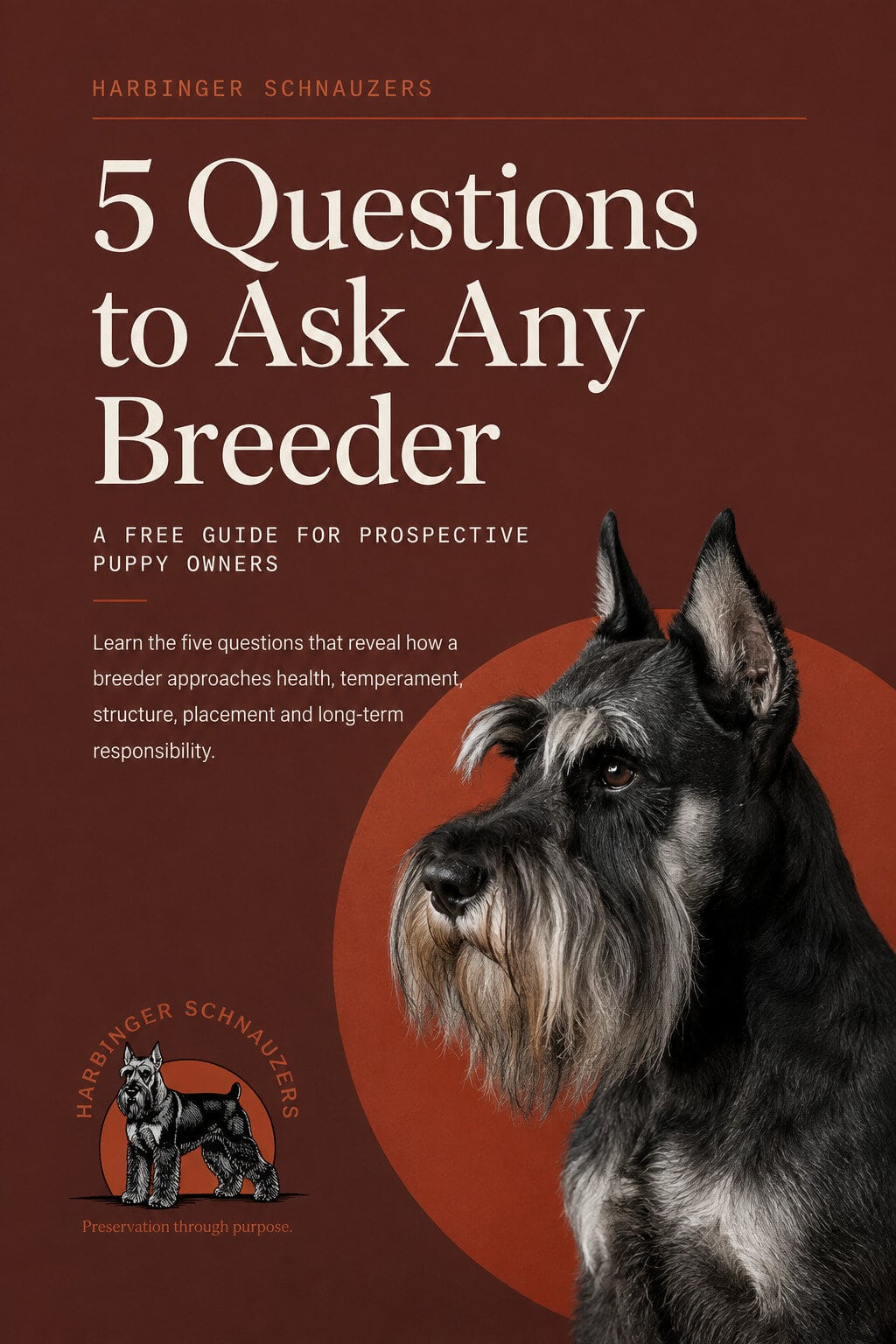
Five questions to ask before you choose any breeder.
You do not need to become a breeder to evaluate one. You simply need to know what questions reveal the information that photographs and promises cannot.
Our free guide helps prospective puppy owners ask better questions about health, temperament, development, contracts and breeder responsibility.
Find the program first. Then find the puppy.
If Harbinger’s approach to health, temperament, structure, development and lifetime responsibility aligns with what you are looking for, we invite you to learn more about upcoming litters and our placement process.